
How Many Ounces Are in a Cup? (Dry and Liquid Conversions)
There are 8 fluid ounces in a cup, but that’s only the full story for liquids. If you’re measuring dry ingredients like flour or sugar, how many ounces are in a cup depends entirely on what you’re measuring, because different ingredients have different weights. My guide below covers everything: liquid conversions, dry ingredient weights, US vs UK cup sizes, and a full FAQ so you’ve always got the right answer to hand, whether you’re following a British recipe or an American one.
Table of Contents
How Many Ounces Are in a Cup of Liquid?
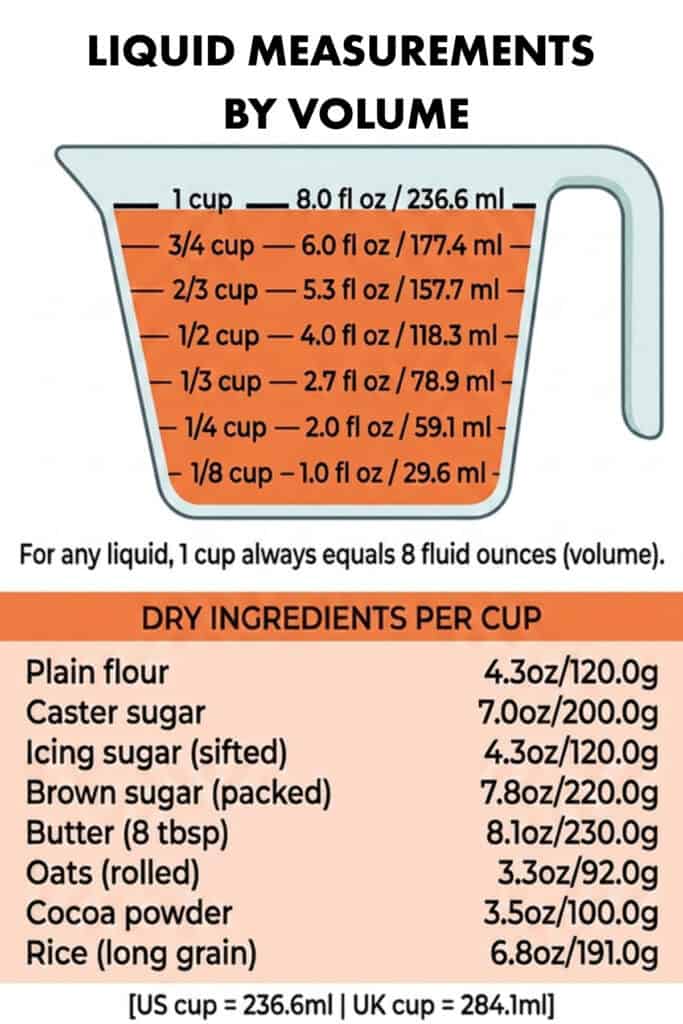
For liquids, it’s pretty simple. One cup always equals 8 fluid ounces, no matter what the liquid is. Here’s the full breakdown of how many ounces are in a cup across every common measurement:
| Cup | Fluid Ounces | Millilitres (ml) |
|---|---|---|
| 1 cup | 8 fl oz | 237ml |
| 3/4 cup | 6 fl oz | 177ml |
| 2/3 cup | 5.3 fl oz | 158ml |
| 1/2 cup | 4 fl oz | 118ml |
| 1/3 cup | 2.7 fl oz | 79ml |
| 1/4 cup | 2 fl oz | 59ml |
| 1/8 cup | 1 fl oz | 30ml |
The conversion is always the same for liquid ingredients: 237ml per cup, which is 8 fluid ounces per cup if you’re in the US. Whether you’re measuring water, milk, oil, cream, or honey, the volume stays consistent even though the actual weight of those liquids differs slightly.
One thing worth knowing: while all liquids measure the same in fluid ounces per cup, their actual weights can differ because of density. A cup of honey, for example, weighs around 12 oz despite only being 8 fl oz in volume. So if a recipe gives you a weight measurement for a liquid ingredient rather than a volume measurement, you’ll need to use a kitchen scale rather than a measuring cup. But that’s not very common!
Pro tip: Keep a clear, spouted measuring jug exclusively for your wet ingredients. When measuring, always set it flat on the counter, pour your liquid, and physically bend down so your eyes are perfectly flush with the measurement line. Looking down from an angle will give you an inaccurate read.
Now you’ve got the measurements down, try making Sweet Potato Brownies, Lemon Muffins and Soft Flapjack Recipe.
How Many Ounces Are in a Cup of Dry Ingredients?
This is where the question of how many ounces are in a cup gets more complicated. Converting oz to cups dry isn’t a straight swap the way it is for liquids, because the answer changes depending on what you’re measuring. Dry ingredients are measured by weight, and weight varies with density. A cup of oats weighs far less than a cup of sugar, even though they take up exactly the same volume.
Here’s a comprehensive dry ingredient conversion table covering the most common baking and cooking ingredients. All weights are based on the spoon-and-level method: spoon the ingredient into the cup rather than scooping directly, then level off the top with a knife.
| Ingredient | 1 Cup (oz) | 1 Cup (grams) |
|---|---|---|
| Plain / all-purpose flour | 4.25 oz | 120g |
| Self-raising flour | 4.25 oz | 120g |
| Wholemeal / whole wheat flour | 4.75 oz | 135g |
| Granulated / caster sugar | 7 oz | 200g |
| Icing / powdered sugar | 4 oz | 115g |
| Brown sugar (packed) | 7.5 oz | 213g |
| Butter | 8 oz | 227g |
| Rolled oats / porridge oats | 3.5 oz | 100g |
| Cocoa powder | 3.5 oz | 100g |
| Rice (uncooked) | 6.5 oz | 185g |
| Chocolate chips | 6 oz | 170g |
| Cream cheese | 8 oz | 225g |
| Dry breadcrumbs | 4 oz | 115g |
Flour is where the measuring method makes the biggest difference. Scoop flour straight from the bag into your cup and you’ll pack it in, ending up with significantly more than the recipe intended. Always spoon flour into the measuring cup loosely and level it off. If you’re baking anything where precision really matters (bread, pastry, anything that can go wrong easily), use a kitchen scale instead.
Pro tip: Invest in a basic digital kitchen scale and start baking by weight (grams/ounces) for guaranteed consistency. If you absolutely must use measuring cups, always use the “spoon-and-level” method: fluff the flour or powder in its container, gently spoon it into your measuring cup until it forms a mound, and smoothly scrape off the excess using the flat spine of a butter knife.
Fluid Ounces vs Dry Ounces: What’s the Difference?
When people ask how many ounces are in a cup, they’re often mixing up two completely different things: fluid ounces and dry ounces.
Fluid ounces measure volume, basically how much space a liquid takes up. Dry ounces measure weight, which is how heavy something is. They’re not the same thing and you cannot directly swap one for the other, except in a few specific cases.
Here’s the practical difference:
- 1 cup of water = 8 fluid ounces (volume) = approximately 8 oz by weight, because water is dense enough that volume and weight happen to align closely.
- 1 cup of flour = 8 fluid ounces (volume) but only about 4.25 oz by weight, because flour is much lighter and less dense than water.
This is why dry ingredients in professional baking are almost always measured by weight rather than volume. A cup of flour scooped straight from the bag can weigh anywhere from 4 oz to 6 oz depending on how packed it is, which is a huge difference that can ruin a recipe. Measuring by weight removes that variable entirely.
So if you’re wondering how many dry ounces are in a cup specifically, the honest answer is that there’s no single number; it completely depends on the ingredient you’re working with.
If you’re in a baking mood, these Shortcake Biscuits, Rice Pudding and Chocolate Cream Cheese Frosting are great next steps.
US Cups vs UK Cups: Does It Matter?
If you cook from both British and American recipes regularly, it’s worth knowing that how many ounces are in a cup differs very slightly depending on which system you’re using.
- An American cup = 240ml = 8 fl oz
- A British cup = 250ml = 8.45 fl oz
In practice, that’s a difference of about 4%, which is small enough that it won’t affect most everyday recipes. If you’re making a vinaigrette or a pasta sauce, the difference between 240ml and 250ml of stock is not going to matter. However for baking, especially anything that involves precise ratios like bread, pastry, or layer cakes, that 4% difference can compound across multiple ingredients and cause issues.
The most practical advice is this: if you’re following a US recipe and you’re in the UK, use metric measurements wherever possible instead of worrying about figuring out how many oz in a cup. Most good recipe sites will give you grams and ml alongside cups and ounces, and those will always be more accurate than trying to convert between cup sizes.
UK recipes rarely use cups at all, by the way. British baking is almost universally done by weight in grams. So if you’re following a UK recipe and it’s calling for cups, it was almost certainly originally an American recipe that’s been adapted — and the cup size used will usually be the US 240ml version.
Other sweet recipes worth trying are Vanilla Sponge Cake, Nutella Puff Pastry and Nutella Blended Baked Oats.
Tips for Dry and Liquid Ingredients: How to Measure Accurately
Knowing how many ounces are in a cup and how to convert ounces to cups is only half the battle. Measuring correctly is what actually makes a difference to your cooking and baking. Here are the things that matter most:
- For dry ingredients, spoon the ingredient loosely into the measuring cup rather than scooping directly from the bag or container. Scooping packs the ingredient down, and you’ll end up with significantly more than intended. This is especially true for flour, icing sugar and cocoa powder.
- Once the cup is full and overflowing slightly, use the straight edge of a knife to level it off. Don’t tap the cup or shake it down.
- Brown sugar is the exception here. Recipes that call for ‘packed’ brown sugar mean you should press it firmly into the cup so it holds its shape when turned out.
- For liquid ingredients, always use a liquid measuring cup with a spout rather than a dry measuring cup.
- Place it on a flat surface and pour the liquid in. Check the measurement at eye level rather than looking down at it from above, because the angle makes a difference to what you see.
Ready to put those measuring skills to work? These are worth making next: Lemon Drizzle Cake, Chocolate Protein Muffins and Banana Bread Cookies.
FAQ
For liquids, yes! 8 fluid ounces equals exactly 1 cup. For dry ingredients, it depends on the ingredient. 8 oz of flour, for example, would actually be closer to 2 cups rather than 1, because flour is much lighter than water.
Half a cup equals 4 fluid ounces or 118ml. For dry ingredients, half a cup of flour is around 2.1 oz, while half a cup of sugar is around 3.5 oz.
One cup of plain or all-purpose flour weighs approximately 4.25 oz or 120g when measured using the spoon-and-level method. If you scoop flour directly from the bag your cup will weigh more, maybe closer to 5–6 oz, which is why spooning and levelling is so important for accurate baking.
One third of a cup equals approximately 2.7 fluid ounces or 79ml. For dry ingredients, 1/3 cup of flour is around 1.4 oz and 1/3 cup of sugar is around 2.3 oz.
Two thirds of a cup equals approximately 5.3 fluid ounces or 158ml. For dry ingredients, 2/3 cup of flour is around 2.8 oz and 2/3 cup of sugar is around 4.6 oz.
Eight fluid ounces equals exactly 1 cup. If you’re measuring a dry ingredient by weight and it’s 8 oz, the cup equivalent depends on the ingredient: 8 oz of butter is 1 cup, but 8 oz of flour is closer to 1.9 cups.
Sixteen fluid ounces equals 2 cups. For dry ingredients the answer varies, 16 oz of sugar is just over 2 cups, while 16 oz of flour is closer to 3.75 cups.
Four fluid ounces equals exactly half a cup. For dry ingredients, 4 oz of flour is just under 1 cup, while 4 oz of sugar is just over half a cup.
Not by weight. 1 cup of granulated or caster sugar weighs approximately 7 oz rather than 8 oz. By volume it is 8 fluid ounces, but sugar is slightly less dense than water so it weighs a little less per cup.
One cup of water equals 8 fluid ounces or approximately 8 oz by weight, since water’s density means volume and weight align closely. It also equals 237ml in the US system or 237ml in the UK system.
More budget-friendly baking to try: Simple Brownies, Vanilla Muffins and Easy Chewy Funfetti Cookies.